Guide · 6 minute read
Bathroom wall panels or tiles: which should you choose?
By Dee Valley Bathrooms · Updated 3 November 2026
The short answer
Wall panels and tiles both work in a bathroom; the difference is time, grout and look. Panels go up in a day or two around a bath or shower, have no grout to clean and cost about the same per square metre as mid-range porcelain once labour is counted, often less. Tiles take two to four days to fix and grout, need the grout refreshing every few years, and give you pattern, texture and the finish buyers still expect to see. For a rental, a quick refurbishment or a shower you want to wipe and forget, panels are the sensible choice. For a bathroom you will sell on, for floors, and for detailed rooms with a lot of cuts, tiles win. Good panels over sound existing tiles are a legitimate shortcut; cheap hollow PVC panels in a shower are not.
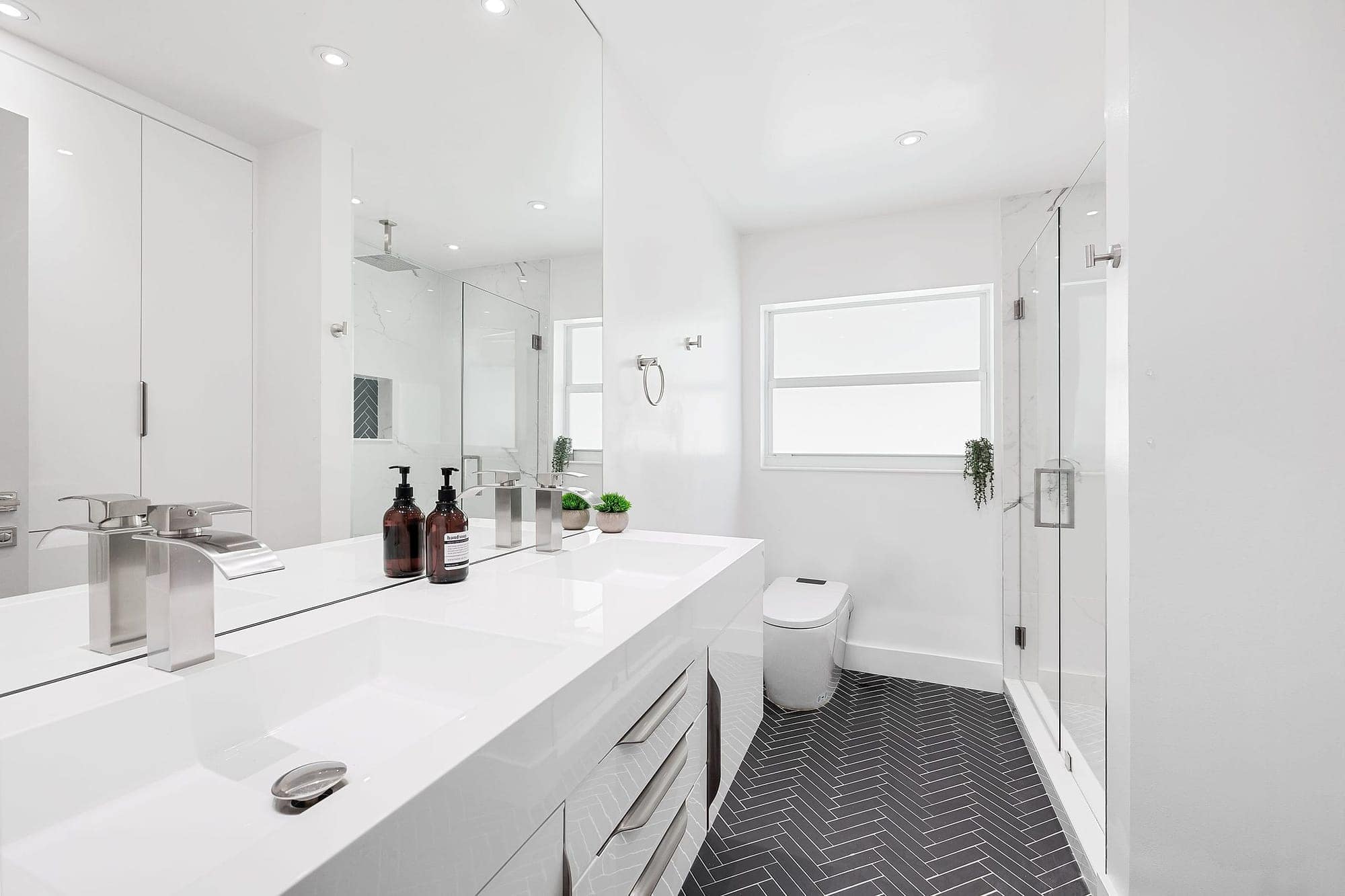
What bathroom wall panels actually are
Wall panel covers three quite different products, and the cheapest one has given the others a bad name. Hollow PVC panels, usually 5 to 10 millimetres thick and clicked together, are light, cheap and quick; they are fine on a ceiling or a dry wall and risky in a shower, because the joints rely on a thin tongue and the panels flex. Laminate panels, a decorative laminate bonded to a moisture-resistant plywood or MDF core around 10 millimetres thick, are the ones most fitters mean when they say wall panels: rigid, sold in sheets of about 2.4 metres by 1.2 or 0.6, joined with sealed tongue-and-groove or aluminium trims, and made to look like tile, stone or concrete. Solid acrylic and stone-resin panels are heavier and more expensive again and are what you see in showrooms.
The laminate type is what we fit around showers and baths. Sealed properly at every edge and joint, with a trim at the top and a bead where the panel meets the tray, it is as waterproof as a tiled wall and quicker to put up.
Tiles against panels
| Item | Tiles | Laminate wall panels |
|---|---|---|
| Look | Any pattern, size, texture; grout lines part of the design | Large uninterrupted sheets; tile and stone effects; few joints |
| Fitted cost per square metre | Mid-range porcelain plus adhesive, grout and two to three days' labour | Similar material cost; labour about half, so often cheaper fitted |
| Time for a shower area | Two to three days including grouting | One day |
| Grout | Needs cleaning and refreshing every few years | None |
| Repairs | One cracked tile can be swapped if you kept spares | A damaged panel means replacing the sheet |
| Floors | Yes | No, wall panels are not floor products |
| Resale | What most buyers expect | Accepted, sometimes read as a budget finish |
| Lifespan | Decades if the substrate is sound | 15 to 20 years for a good laminate, less for hollow PVC |
Where panels are the better choice
- Rental properties and HMOs, where speed between tenants and no grout to go black matter more than pattern.
- A refurbishment on a budget where the existing tiles are sound and flat: panels can go straight over them.
- Around a bath or in a shower where you want one wipe-clean surface with no joints to scrub.
- Rooms with long, plain walls and few obstacles, where a 2.4 metre sheet covers the wall in one piece.
- Anywhere the walls are out of true: panels bridge small irregularities that large tiles would show.
Where tiles win
- Floors, always. There is no wall panel that belongs on a bathroom floor.
- Small rooms with many cuts, windows, boxings and pipes: panel offcuts are waste, and every cut edge is a joint to seal.
- Pattern and detail: herringbone, metro, encaustic effects, a feature wall, a niche with a contrasting tile.
- A house you will sell soon, where buyers expect tiles and may discount a panelled bathroom.
- Anywhere you want to repair rather than replace: a spare box of tiles fixes a chip; a scratched panel is a new sheet.
How panels are fitted so they last
The panel is only as good as its fixing, and the fixing is a sequence. The wall is checked for flatness and dryness first; a panel bridges small bumps, but a wall that is damp behind will push the adhesive off within a year. Panels are cut to size with a fine-tooth blade, a few millimetres short of the ceiling and of the tray, and every cut edge that will sit near water is sealed before the panel goes up, because the core is what fails, not the face. A high-grab adhesive goes on in vertical beads so any moisture that does get behind can run down and out rather than sitting in a pocket.
The joints are the second place a panel wall lives or dies. Tongue-and-groove panels get a bead of sealant in the groove before they are pushed home; trimmed systems get the aluminium or PVC trim bedded in sealant. Internal corners take a corner trim or a sealed butt joint, never a bare cut edge. At the bottom, the panel stops just above the tray or bath and the gap is filled with a continuous bead of silicone, applied once to a clean, dry joint and left for a day. At the top, a trim or a bead of sealant stops condensation from running down the wall and behind the panel. Done in that order, a laminate panel wall outlasts the grout in the tiled room next door.
Panels over existing tiles
This is the question we get most, and the answer is a careful yes. If the existing tiles are firmly fixed, reasonably flat and the wall behind them is dry, laminate panels can be fixed over them with the right adhesive, and you save the rip-out, the making good and a day or two. We tap every tile first; a hollow sound means loose tiles and the shortcut is off. The depth matters too: tiles plus panel plus adhesive takes 20 to 25 millimetres off the room, which around a bath can mean a tray or screen no longer fits. We measure that before quoting.
What we will not do is panel over tiles that have been wet behind, or over a window reveal where the panel would have to be cut into slivers. In those cases the tiles come off.
The mistakes we see
Most panel failures are not the panel. They are an unsealed cut edge at the bottom where the panel meets the tray, so the core drinks water and swells; a joint without sealant in the tongue; no trim at the top so condensation runs behind; or a hollow PVC panel in a shower flexing until a joint opens. Fitted by someone who treats the sealing as part of the job rather than the end of it, a laminate panel wall is a good, long-lasting finish.
Ask one question
Ask what the panel is made of. If the answer is hollow PVC and it is going in a shower, ask for the laminate alternative. The price difference is small and the difference in ten years is the whole wall.
Questions people ask
Are bathroom wall panels cheaper than tiles?
Fitted, usually yes. The panels themselves cost about the same per square metre as mid-range porcelain, but a shower area takes a day to panel against two to three days to tile and grout, so the labour is roughly half. Hollow PVC panels are cheaper still, and not something we would put in a shower.
Do bathroom wall panels look cheap?
Hollow PVC panels with visible click joints can. Laminate panels with a stone or concrete effect, fitted with aluminium trims or sealed tongue-and-groove joints, read as a modern finish and many people cannot tell them from large-format tile. Buyers still tend to expect tiles, so weigh that if you are selling.
What is the lifespan of bathroom wall panels?
A good laminate panel, sealed at every edge and joint, lasts 15 to 20 years in a shower. Hollow PVC lasts less, and fails sooner if the joints flex. The failure point is almost always an unsealed cut edge at the bottom or a missing top trim, not the panel face.
Can you put wall panels over tiles?
Yes, if the tiles are firmly fixed, flat and dry behind, with the right adhesive and every edge sealed. We tap every tile first and measure the depth lost, because tiles plus panel can stop a tray or screen fitting. Loose or damp tiles come off first.
Do wall panels leak?
Not when the joints and edges are sealed and the bottom edge is kept off the tray with a bead of silicone. Leaks come from unsealed cut edges that let the core swell, joints without sealant, or thin PVC panels flexing. A laminate panel system fitted properly is as waterproof as tiling.
Next step
Tell us about your bathroom
Send a few photos of the room and a line about what you want changed. You get a free survey, an itemised quote in writing and a start date, and nobody chases you if you decide to wait.
Quotes are free, itemised and in writing. The price you agree is the price you pay unless you change the job.