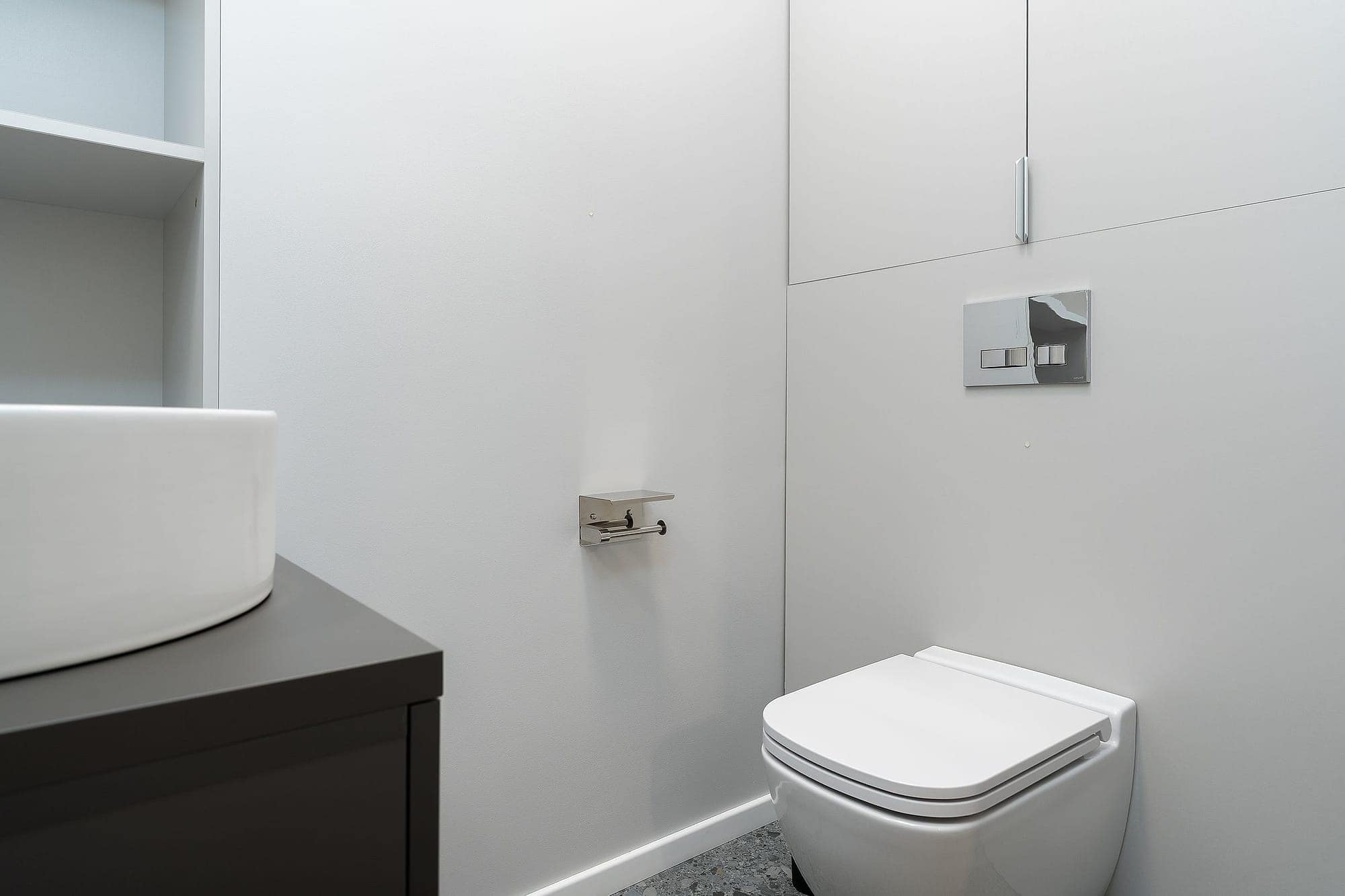
What makes a small bathroom feel bigger
Floor you can see. A wall-hung toilet and a wall-hung vanity show a continuous floor under them, and a continuous floor reads as space. Large tiles with few grout lines do the same, especially when the floor tile continues into a level shower area. Glass instead of a shower curtain, a wide mirror, and light in the right places finish it.
What makes a small bathroom feel smaller is clutter: a pedestal basin with no storage, a bath nobody uses, a shower curtain, a boxy cistern, a cabinet on every wall. Most of our small bathroom jobs start by taking things out.
The layouts that work in this area's houses
Victorian and Edwardian terraces (Wrexham, Chester, Oswestry) often have a bathroom in the back addition, long and narrow with the window at the end. A walk-in shower across the narrow end, vanity and toilet along one wall, works well and keeps the window.
1930s and post-war semis usually have a near-square room over the hallway, around 2 by 2 metres. Bath along the window wall or a 1200 shower there, toilet and basin opposite. If you want both bath and shower, an L-shaped shower bath with a fixed screen is the honest answer.
1960s to 1990s estate houses often have a separate toilet beside a tiny bathroom. Knocking through, where the wall is not structural, gives you one proper room, and it is a change we do often.
Ensuites in new-builds are the smallest rooms of all, and they get their own page.
Products that earn their place in a small room
- Short-projection toilets (around 600 millimetres front to back) and wall-hung pans with the cistern in a frame.
- Slimline or cloakroom-depth vanities, 350 to 400 millimetres deep, with a basin that still takes a face wash.
- Walk-in shower with a single fixed glass panel, not a door that swings into the room.
- Recessed niches built into the stud wall for shampoo, so nothing sits on the tray.
- A mirror cabinet with lights and a shaver socket inside, so the wall stays clear.
- A heated towel rail sized for the room, which heats it and dries the towels, instead of a radiator and a rail.
Tiles, panels and colour
Big tiles in a small room is not a mistake; it is usually the right call, because fewer grout lines calm the room. Running the floor tile up the shower wall, or the wall tile across the floor, makes the space read as one. Light does not have to mean white: warm greys, soft greens and stone colours work, as long as the room has enough light. Wall panels are a good small-room option too, because there is no grout to keep clean and a 2.4 metre panel covers a whole wall without a joint.