Guide · 7 minute read
Building regulations and electrics in a bathroom: what applies
By Dee Valley Bathrooms · Updated 3 November 2026
The short answer
Replacing a bathroom suite like for like, in the same positions, does not normally need Building Regulations approval in England or Wales. The moment the job goes beyond that, it can: a new drainage connection or a bathroom where there was none (Parts H and G), removing or altering a wall (Part A), most electrical work in a bathroom (Part P), and ventilation when you add a bathroom or there is no openable window (Part F, which expects an extractor rated at 15 litres a second). Wales sets its own Building Regulations but follows the same Approved Document structure. In practice the plumbing and tiling rarely need notifying, the electrics almost always do, and the simplest way to comply is for a registered electrician to do and certify that work. When in doubt, ask your council's building control before the job starts, not after.
When a bathroom job needs Building Regulations
Building Regulations are not planning permission. Planning is about what a building looks like and how it is used; the regulations are about whether the work is safe and sound. A bathroom almost never needs planning. It sometimes needs the regulations, and the table below is the usual pattern. Rules are applied by your local building control, so treat this as a guide and ask them if your job is unusual.
| Work | Regulations involved | Who deals with it |
|---|---|---|
| Like-for-like replacement of suite, tiles, floor | Normally none | Nobody; just do the work properly |
| Moving a toilet, basin or bath on existing drainage | Usually not notifiable if the existing drainage is used | Fitter does it to standard; check if a new connection is needed |
| New connection to the drainage, or a new bathroom where there was none | Part H (drainage), Part G (sanitation and hot water) | A building notice to the council, or the fitter's chosen route; inspection before the floor closes |
| Removing or altering a wall | Part A (structure) if load-bearing | Building notice; a structural engineer if a beam is needed |
| New circuits, new wiring in the bathroom, fan, shower, underfloor heating | Part P (electrical safety) and BS 7671 | A registered electrician self-certifies and notifies the council |
| Adding a bathroom with no openable window | Part F (ventilation) | Extractor to the required rate, usually dealt with alongside the electrics |
| Lead or old pipework replaced, new hot water supply | Part G and the Water Regulations | The plumber works to the Water Regulations; some new installations need notifying to the water company |
A guide, not legal advice. Your local building control has the final word on what needs notifying.
Electrics: why a bathroom is a special location
The wiring regulations treat a room with a bath or shower as a special location, because wet skin and mains electricity do not mix. The room is divided into zones measured from the bath or shower, and every electrical item must be rated for the zone it sits in. Part P of the Building Regulations then says that most electrical work in a bathroom, beyond swapping a like-for-like fitting, must be notified to building control. The two rules together are why a plumber or a fitter should not be wiring your bathroom.
| Zone | Where it is | What is allowed |
|---|---|---|
| Zone 0 | Inside the bath or the shower tray | Only fittings rated at least IPX7 and running at very low voltage (12 volt SELV) |
| Zone 1 | Above the bath or shower to 2.25 metres from the floor | Fittings rated at least IPX4 (IPX5 if a jet is used for cleaning); items made for the zone such as electric showers and suitable fans |
| Zone 2 | 0.6 metres beyond zone 1, to 2.25 metres high | Fittings rated at least IPX4; shaver sockets to the bathroom standard are permitted here |
| Outside the zones | The rest of the room | No specific IP rating required, but ordinary 13 amp sockets must be at least 3 metres from the edge of the bath or shower, which rules them out of most bathrooms |
What a registered electrician gives you
An electrician registered with a competent person scheme (NICEIC, NAPIT and others) can self-certify notifiable work. They do the job, test it, issue an Electrical Installation Certificate or a Minor Works Certificate, and notify the council through their scheme, which sends you a Building Regulations compliance certificate, normally within a month. You pay no council fee and nobody comes to inspect. Keep both documents: a buyer's solicitor will ask for them.
The alternative is for an unregistered person to do the work under a building notice, with the council inspecting and charging a fee, and often requiring a separate test by a qualified electrician anyway. It is slower and usually dearer. This is why on our jobs the electrics are done by a registered electrician we work with, and why you receive the certificate at handover.
Showers, towel rails, fans and underfloor heating
- Electric showers need their own circuit from the consumer unit, sized to the shower's rating (a 9.5 kilowatt shower draws over 40 amps), protected by an RCD, and controlled by a double-pole isolator, usually a pull cord in the room or a switch outside the door.
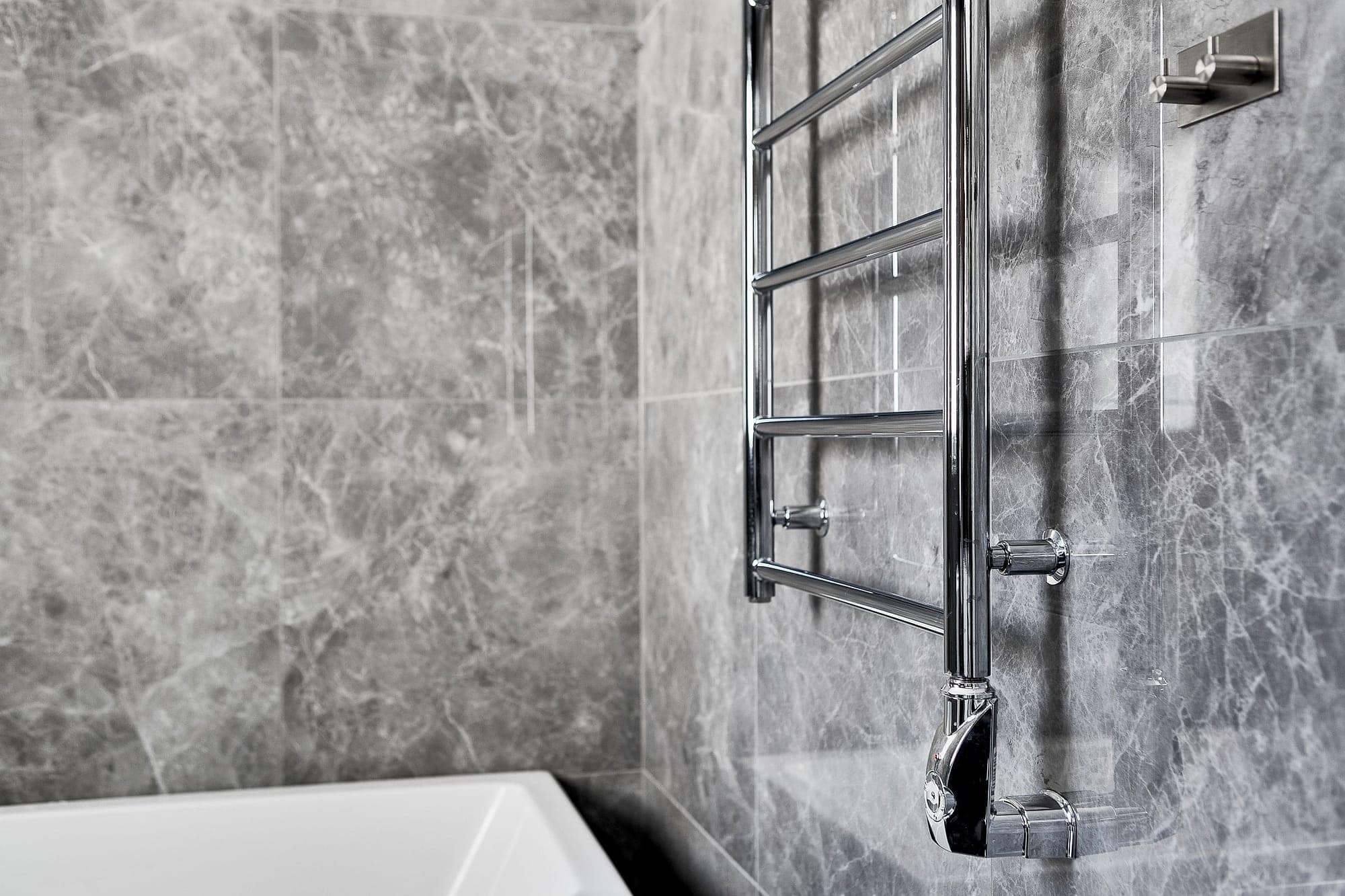
- Electric heated towel rails are wired to a fused spur outside the zones, not plugged in. Dual-fuel rails run on the central heating and have an element for summer.
- Extractor fans in zone 1 or 2 must be rated for the zone, usually IPX4 or better, and most are wired through an isolator so they can be worked on safely.
- Electric underfloor heating is a new circuit or a fused spur with RCD protection, with the thermostat mounted outside the zones. It is notifiable work.
- Shaver sockets must be the bathroom type with an isolating transformer. Ordinary sockets, USB outlets and extension leads do not belong in a bathroom.
- Lighting in the zones must carry the right IP rating; downlights over a shower are commonly IP65, and a lit mirror must be rated for where it hangs.
Ventilation: Part F
Approved Document F expects a bathroom to have mechanical extract at 15 litres a second if the fan runs intermittently, or 8 litres a second if it runs continuously, with a lower rate for a toilet with no bath or shower. Where there is no openable window, the fan should keep running for a period after the light goes off, which is what the overrun timer on most fans does. Humidity-sensing fans switch themselves on when the air gets damp and are a good fit for family bathrooms. The duct should take the shortest sensible route to the outside, insulated where it runs through a cold loft so condensation does not run back into the fan. A fan that vents into the loft is not ventilation; it is a damp problem waiting upstairs.
England and Wales
Wales has had its own Building Regulations since 2011, made by the Welsh Government, and its own versions of the Approved Documents. For a bathroom the practical requirements are the same as in England: Part P applies, the ventilation rates match, and the notification routes are the same. If your house is in Wrexham, Flintshire or Denbighshire the council's building control is the authority; in Chester, Shropshire or the Wirral it is the English council. Either way, a registered electrician's certificate is accepted on both sides of the border.
The short version
Plumbing and tiling: do it properly. Drainage and walls: check with building control. Electrics: use a registered electrician and keep the certificate. That covers almost every bathroom.
Questions people ask
Do I need building regulations to replace a bathroom?
Not for a like-for-like replacement of the suite, tiles and floor in the same positions. You do once the job adds a new drainage connection, creates a bathroom where there was none, alters a load-bearing wall or involves electrical work in the room, which under Part P is almost always notifiable. Check with your council's building control if unsure.
Can a plumber do electrical work in a bathroom?
Only if that plumber is also registered with an electrical competent person scheme, which is rare. Electrical work in a bathroom is notifiable under Part P, and a registered electrician can self-certify it and issue the certificates. An unregistered person would need a building notice and a council inspection.
Can you have a normal plug socket in a bathroom?
Only if it is at least 3 metres from the edge of the bath or shower, which rules it out of almost every domestic bathroom. The permitted outlet is a shaver socket with an isolating transformer, in zone 2 or beyond. Towel rails and fans are wired to fused spurs, not plugged in.
Does a bathroom have to have an extractor fan?
If the room has no openable window, yes. If it has one, the regulations are satisfied by the window, but an extractor is still the sensible choice because nobody opens a window in January. The expected rate is 15 litres a second for an intermittent fan, with an overrun timer where there is no window.
What certificate should I get after bathroom electrics?
Two documents: an Electrical Installation Certificate or Minor Works Certificate from the electrician showing the test results, and a Building Regulations compliance certificate sent through their scheme, usually within a month. Keep both; a buyer's solicitor will ask for them when you sell.
Do I need planning permission for a bathroom?
Almost never for a bathroom inside an existing house. Planning concerns the outside and the use of the building. The exceptions are a listed building, where internal changes can need consent, and a new external vent or soil pipe on a building in a conservation area, where it is worth asking the council first.
Next step
Tell us about your bathroom
Send a few photos of the room and a line about what you want changed. You get a free survey, an itemised quote in writing and a start date, and nobody chases you if you decide to wait.
Quotes are free, itemised and in writing. The price you agree is the price you pay unless you change the job.